Which Social Media Platform Should Your Business Be On?
Bad news, there is NO correct answer.
Sorry, but that’s the truth.
The real question is: “Which platform helps our business communicate best?”
Because when the platform matches your business goals, your content suddenly has direction. And direction changes everything.
BUT I want you to consider something for a minute….
Let’s talk ‘cars’.
Imagine if everyone drove around in the same car.
Same colour. Same size. Same model. (The most lame car park in history.)
Pretty boring, right? And that giant off-road 4WD your neighbour owns because he loves to go camping every weekend probably is not the best choice for your quick commute to the office.
So, why do businesses treat social media platforms like they are all the same?
(Copy, paste, post, repeat… sound familiar?)
Jumping on whatever everyone else is doing. Posting everywhere. Without actually asking themselves if that platform suits their audience, their industry or their goals.
Different platforms attract different audiences, reward different types of content and serve different business purposes.
So…. let’s break it down and ask the question you should actually be asking: Which social media platform actually makes sense for my business?
Download our free Social Media Quiz below. You might just be surprised by the answer!
Why being everywhere rarely works
There’s a common belief floating around the marketing world that businesses need to be on every social media platform.
Instagram. Facebook. LinkedIn. TikTok.
Maybe Pinterest… just in case.
Ewww… sounds tiring right?
And… trying to show up everywhere often creates the opposite effect. Instead of building a strong presence on one or two platforms, businesses end up stretching their time, energy and content across too many places. So let me guess.. does this sound like what you are doing atm?
Step 1: post content that becomes rushed or inconsistent
Step 2: content starts feeling repetitive
Step 3: engagement stays low
Step 4: the whole thing begins to feel like a chore… so you give up!
(And if social media feels like a chore, chances are your audience can feel that too.)
Trust bomb time….?
Strong social media strategies are rarely about doing more.
They are about doing the right things in the right places.
Showing up consistently on one or two platforms where your audience is already active will almost always outperform trying to maintain five different accounts that never quite get the attention they need.
Start with your audience
Before choosing a social media platform, ask yourself one very simple question.
“Where is your audience actually hanging out online?”
Not where you like scrolling. Not where the latest marketing guru told you to be.
Because social media platforms aren’t empty stages waiting for your brand to perform. They’re already rooms full of people doing their thing.
Your job isn’t to be everywhere. Your job is to show up where your audience already is. So before you jump on another platform, ask:
• Where does our audience spend time online?
• How do they like to consume content?
• How do they research businesses like ours?
Because when the platform fits the audience… social media suddenly makes a lot more sense!
Match platforms to business goals
Different social media platforms serve different purposes.
Sounds obvious… but you’d be surprised how many businesses skip this step.
Instead they jump on a platform simply because: “Everyone else is on it.” (Not exactly a strategy.)
Each platform supports different business goals and different ways of communicating.
For example:
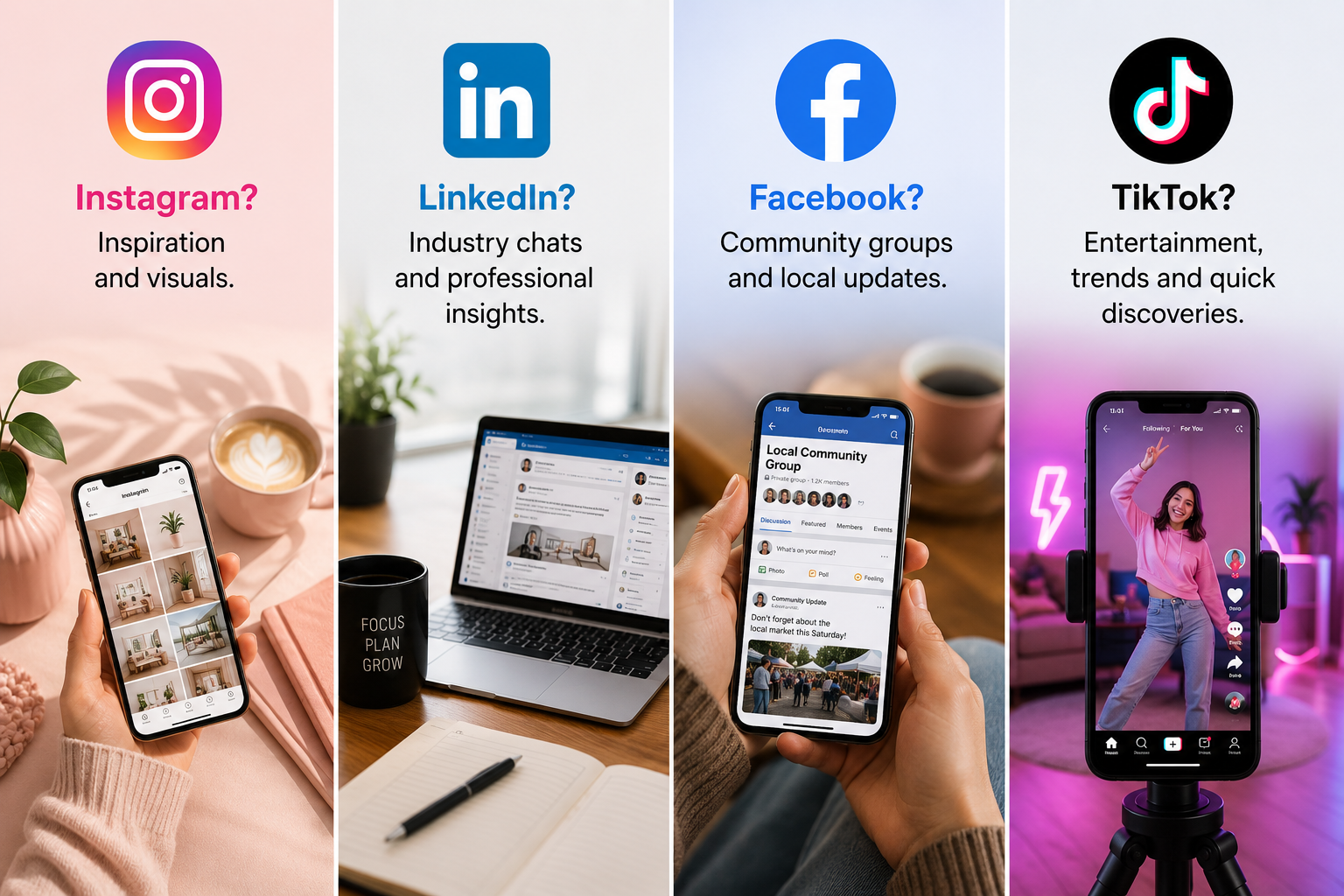
Instagram?: Great for visual storytelling and building strong brand presence.
LinkedIn?: Ideal for professional networking, industry insights and B2B conversations.
Facebook?: Still really powerful for local businesses, community updates and customer interaction.
TikTok?: Fast, creative and great for brands that want to show personality and reach younger audiences.
The real question isn’t “Which platform is popular?” It is more: “Which platform helps our business communicate best?”
Because when the platform matches your business goals, your content suddenly has direction. And direction changes everything.
Strategy comes before content…. always!
Here’s a little truth bomb. (Go-go-gadget truth bomb?)
Posting more content is not a strategy…….It’s just… posting more content.
And yet, this is where many businesses start with social media.
“Let’s post more.”
“Let’s try reels.”
“Let’s jump on TikTok.”
Without first asking the important questions like:
“Who are we actually speaking to?”
“How do they like to be spoken to?”
“What are we trying to achieve?”
and
“Which platform makes the most sense for our business?”
Because strong social media strategies always begin with clarity.
Clarity on your audience, clarity on your business goals, clarity on which platforms actually make sense and clarity on how your brand communicates.
Content should support the strategy. Not replace it.
Because when the strategy is clear, content suddenly becomes a whole lot easier to create. And a whole lot more effective.
Not sure where your business should actually show up online?
If reading this made you realise your social media approach might be a little… improvised (no judgement here), a strategy session can help bring some clarity.
At Black Owl Design, we work with businesses to map out a practical, easy-to-follow social media strategy that aligns with their audience, their business goals and the way they want their brand to show up online.
Instead of guessing what to post or jumping between platforms, you walk away with a clear plan that acts as your social media playbook moving forward.
Download our free Social Media Platform Quiz below and learn which platform is best for YOUR business.
If you’re looking for quick answers to some of the most common questions businesses ask about social media platforms and strategy, here are a few helpful starting points from the team at Black Owl Design in Mackay, specialists in Social Media Strategies.
-
For most businesses, the best social media platform depends on where your audience spends time online and how that audience prefers to consume content. Success comes from focusing on one or two platforms that align with your audience and business goals of your brand. When your energy and attention are concentrated in the right places, your brand is far more likely to build a recognisable presence, maintain consistency and develop content that genuinely connects with your audience.
-
Choosing the right social media platform usually starts by understanding your audience behaviour. Instead, you should consider questions such as:
Where does your audience spend time online?
What type of content do they engage with most?
How do they research businesses like yours?
Which platforms support the way your brand communicates?
When platform selection is based on audience behaviour and your business goals, social media becomes far more strategic and easier to manage.
-
Instagram is highly visual and often where people explore brands, products, aesthetics and lifestyle inspiration. It’s a platform built around imagery, short-form video and visual storytelling. Businesses often use Instagram to showcase their work, highlight products or services but also give audiences a glimpse behind the scenes of how things happen within a brand. If you and your brand can create these types of content pieces, Instagram might be a wonderful social media marketing app to use:
before-and-after transformations
product showcases or service highlights
short educational reels or tips
behind-the-scenes studio or workplace moments
brand storytelling through carousels
team culture and day-to-day business life
Because Instagram prioritises visual engagement, it needs strong imagery, thoughtful design and consistent branding to perform best.
-
Facebook continues to play an important role in community interaction, particularly for local and service-based businesses and many users rely on Facebook to keep up with community news, local recommendations and business updates. If your brand is operating within specific regions or towns, Facebook can be an effective place to stay visible and accessible. Successful content on Facebook often includes:
business updates or announcements
project photos or completed work
customer testimonials or reviews
local community involvement or events
helpful tips or seasonal advice
links to blog articles or longer-form content
Facebook groups and community pages can also make it easier for your businesses to engage directly with local audiences, answer questions and build familiarity within your region.
-
TikTok is fast-moving and widely used for entertainment, so it’s often where creativity, personality and short-form storytelling take centre stage. The platform is designed around quick, engaging videos that often combine trends, humour, education and authenticity. While TikTok originally gained popularity with younger audiences, it has grown into a discovery platform where businesses can reach new people through engaging content, regardless of age, location or demographic. If you can create the following types of content for TikTok, it could be suitable for your brand:
short educational tips or quick advice
behind-the-scenes workplace moments
time-lapse processes or transformations
trend-based content adapted to your industry
personality-led videos that humanise your brand
quick myth-busting or “did you know” style content
Success on TikTok tends to rely less on polished production and more on authenticity, creativity and clear communication.
-
LinkedIn is built around professional conversations, industry insights and business networking. People generally visit LinkedIn to learn, connect and stay informed about what is happening within their industry and those of their clients and suppliers. LinkedIn could be effective for your businesses if you wish to position yourseklf as experts or share knowledge that supports your audience. Content on LinkedIn often performs best when it provides value or perspective. If you can create and share the following types of content, LinkedIn might be suitable for you:
industry insights or commentary
lessons learned from projects or case studies
educational breakdowns of processes or strategies
team milestones or company updates
long-form posts that share your experience or expertise
blog articles that explore industry topics in more depth
Compared to other platforms, LinkedIn tends to reward thoughtful, informative content that contributes to professional discussions.
-
Yes, because let me see if I am right in explaining what you might be doing at the moment??? Bonus points if I hear you say to yourself ‘wow that sounds like me’….
Social media posting begins with enthusiasm, but as the workload within your business grows, consistency starts to slip. Your content becomes rushed, posting schedules become irregular and messaging begins to feel repetitive. Engagement rarely improves because the effort being spread across multiple platforms prevents any single one from being developed properly and over time, the process becomes exhausting.
How did I go? True, right? Social media starts to feel like another task on the never-ending business to-do list rather than a valuable marketing tool that actually supports growth.
A written social media strategy provides clarity and direction for how your business approaches social media marketing. It acts as a reference document that outlines your target audience, business goals, priority platforms, content themes and success metrics. This makes it easier your brand to plan content, stay consistent and measure whether your efforts are working.
Many businesses choose to work with studios like us at Black Owl Design in Mackay to develop a structured social media strategy that aligns with their audience, their business goals and the way they want their brand to communicate online.
-
Yes. A clear social media strategy should guide content creation rather than the other way around. A strong strategy outlines your businesses audience, business goals, priority platforms, messaging direction and content themes. This provides a framework that helps you decide what content to create and why.
Without a strategy, businesses often post reactively, experiment randomly with platforms or chase trends without a clear direction. When strategy comes first, content becomes easier to plan, more consistent and more aligned with the long-term goals of the business.
-
Posting frequency is less important than consistency and quality. Instead of trying to post every day, your business would benefit from choosing a realistic schedule that you can maintain over time. For many brands, this may be two to three posts per week on their primary platform.
A consistent posting rhythm helps audiences recognise your brand, understand ityour messaging and engage with your content over time.
-
A written social media strategy provides clarity and direction for how a business approaches social media marketing. It acts as a reference document that outlines the target audience, business goals, priority platforms, content themes and success metrics. This makes it easier for businesses to plan content, stay consistent and measure whether their efforts are working.
Many businesses choose to work with studios like us at Black Owl Design in Mackay to develop a structured social media strategy that aligns with their audience, their business goals and the way they want their brand to communicate online.
-
In many ways, you can think of it as a social media playbook for your business. A bible if you will!! (Not a dusty document that gets written once and forgotten, but something you can actually refer back to when planning content, making decisions or reviewing what’s working.)
A fantastic strategy will usually outline things such as:
• your target audience and how they behave online
• the role social media plays within your overall business strategy
• which platforms make the most sense to prioritise for your own brand
• the tone of voice and personality of your brand
• key content themes or messaging pillars
• what success actually looks like and how it will be measured for you